Monday, September 3, 2012

Speckled Kingsnake


Prairie chicken tracking day!  I love my day on the prairie.  It is so peaceful and there is always something interesting to observe.   When I hopped out of the tracking truck to open a pasture gate, I noticed that something in the grass at the edge of the road looked “different”.  What do you see here?  I left the gate halfway open and grabbed my camera from the truck.

Speckled Kingsnake
 It is a Speckled Kingsnake, Lampropeltis getula holbrooki.  This is gorgeous, native, non-venomous, East Texas snake.  A few years ago, there was a pair of mature Speckled Kingsnakes who liked to bask in the garden and on the patio of the Prairie Preserve office.   Those snakes were 5-6 feet long.  I am sure they managed the rodent population efficiently.


This fellow near the pasture gate was only about 3 feet long.  I got close to snap a photo, but he did not like that one bit.  First he coiled defensively, then he raised his head and made a hasty retreat.  I assured him that I did not eat snakes, but he was taking no chances.  It was just as well that he moved - as close as he was to the road, I might have accidentally driven over him with the truck.

This is a very attractive snake.   The black dorsal scales have a spot of yellow – a light on the shield if you will - thus the Latin name, Lampropeltis.  Lampro refers to torch or lamp.  Peltis refers to a crescent-shaped shield.    Speckled Kingsnakes hunt by scent and kill their prey by constriction.   According to A field Guide to Snakes of Texas by Alan Tennant, Speckled Kingsnakes eat small mammals, birds, lizards, frogs, and turtle eggs.  They also eat other snakes including coral snakes, copperheads, and rattlesnakes.   “Kingsnakes are largely immune to Crotalid venom,” Tennant says.  Cool, right?  King of the snakes!
Speckled Kingsnake, Lampropeltis getula holbrooki
 

Tuesday, July 31, 2012

Bee Fly


Bee Fly on Mexican Heather
Winnie the Pooh searching for honey - that’s what I think of when I see this little insect that resembles a plush Teddy bear.  It’s a Bee Fly!  I spotted this fuzzy, golden critter hovering over the Mexican Heather blossoms, searching for nectar.  The purple Mexican Heather flowers, Cuphea hyssopifolia, are only about 1 cm in diameter,  so you can see that the Bee Fly is smaller still.  My books tell me that these tiny pollinators, family Bombyliidae, do not bite or sting, no matter how pointy they appear.  The long proboscis is designed for sipping nectar.  Bee Fly larvae are parasites of other garden insects such as ground nesting bees and beetles.   This was the first one I’d seen.  I think he is adorable.
Bee Fly on Mexican Heather
Bee Fly on Mexican Heather - doesn't he look soft?
Bee Fly:  Wheeee!  Coming in for a landing,  Note the ant peeking from the flower.
Bee Fly on Mexican Heather


Saturday, June 30, 2012

Nash Prairie Fritillaries and Phaon Crescent

Flamboyant Passion-flower Blossom, Passiflora incarnata.


As we were departing Nash Prairie, someone noticed Passion-flower, Passiflora incarnata,  blooming on a barbed-wire fence near our truck. On the Passion-flower leaves there were the dramatic caterpillars of the Gulf Fritillary.   Scott, my fellow Master Naturalist, held back the leaves so I could snap a picture.  Back in the truck,  we started to drive away,  when Aaron, the Project Director, spotted an unfamiliar butterfly.  We all jumped out of the vehicle to look and identify.   Thank goodness for digital cameras:  it is much easier to examine a critter from a picture, back at home, after a shower, with all the field guide books handy.  I decided that the mystery butterfly was a Varigated Fritillary, Euptoieta claudia.  The Varigated Fritillary also uses Passion-flower as a larval host! If anyone has a different identification for it, please let me know!

Before coming to the Nash Prairie, I had not seen a tiny Phaon Crescent, Phyciodes phaon.  I grow a lot of its larval host plant, Frog Fruit, Phyla, as a ground cover at my house.

Larva of Gulf Fritillary, Agraulis vanillae, munching on Passionflower leaves


Plump, glossy, purple and orange striped caterpillar of Gulf Fritillary butterfly on Passionflower leaves
Varigated Fritillary, Euptoieta claudia, nectaring on Brazilian Vervain

Another view: Varigated Fritillary nectaring on Brazilian Vervain
Phaon Crescent nectaring on Frog Fruit.  Frog Fruit is also its larval host
Another view: Phaon Crescent, Phyciodes phaon, nectaring on Frog Fruit

Nash Prairie

Halloween Pennant, Celithemis eponina, at Nash Prairie, June 2012

Nash Prairie Trip 06/24/2012
Imagine the Texas coastal landscape back in the time before Europeans arrived with plows and cattle.  That is the Nash Prairie Preserve today - a sparkling remnant of the Coastal Tallgrass Prairie that once swept from Corpus Christi, TX to Lafayette, LA.   This precious habitat is home to ancient, rare and previously-thought-to-be-extinct plants, along with their accompanying communities of insects and animals.  The Nash Prairie Preserve, managed by the Nature Conservancy, is an indispensable resource for seeds which are used in prairie restoration projects.

This was my first visit to the Nash Prairie. I was part of a seed-collecting team that departed from the Texas City Prairie Preserve.  On this hot June morning, the Rattlesnake Master, Eryngium yuccifolium was spectacular in full bloom; if the Nash Prairie were a giant cookie then the Rattlesnake Master was the white sugar coating the top!  What a marvelous sight.  Purple Liatris streaked throughout along with sprinkles of yellow Rosinweed.  Pimple Mounds, covered with yellow Coneflowers, stood out in brilliant relief.

Meadow Larks, Quail, Dicksisssels, and Red-winged Blackbirds sang while we gathered seeds of Prairie Parsley and Rosinweed.  Scores of the whimsically named Halloween Pennant Dragonflies skipped and gamboled over the tops of the grasses.  Butterflies, snails, and teal-green beetles – at every step there was another marvel and more to learn!
Rattlesnake Master blooming on Nash Prairie, June 2012

Snails in the Rattlesnake Master
Snail on Rattlesnake Master, Nash Prairie.
 
Empty Black Swallowtail Chrysalis on Rattlesnake Master

Rosinweed, Silphium

Coneflower, Rudbeckia texana, with Funereal Duskywing

Eastern Amberwing, Perithemis tenera

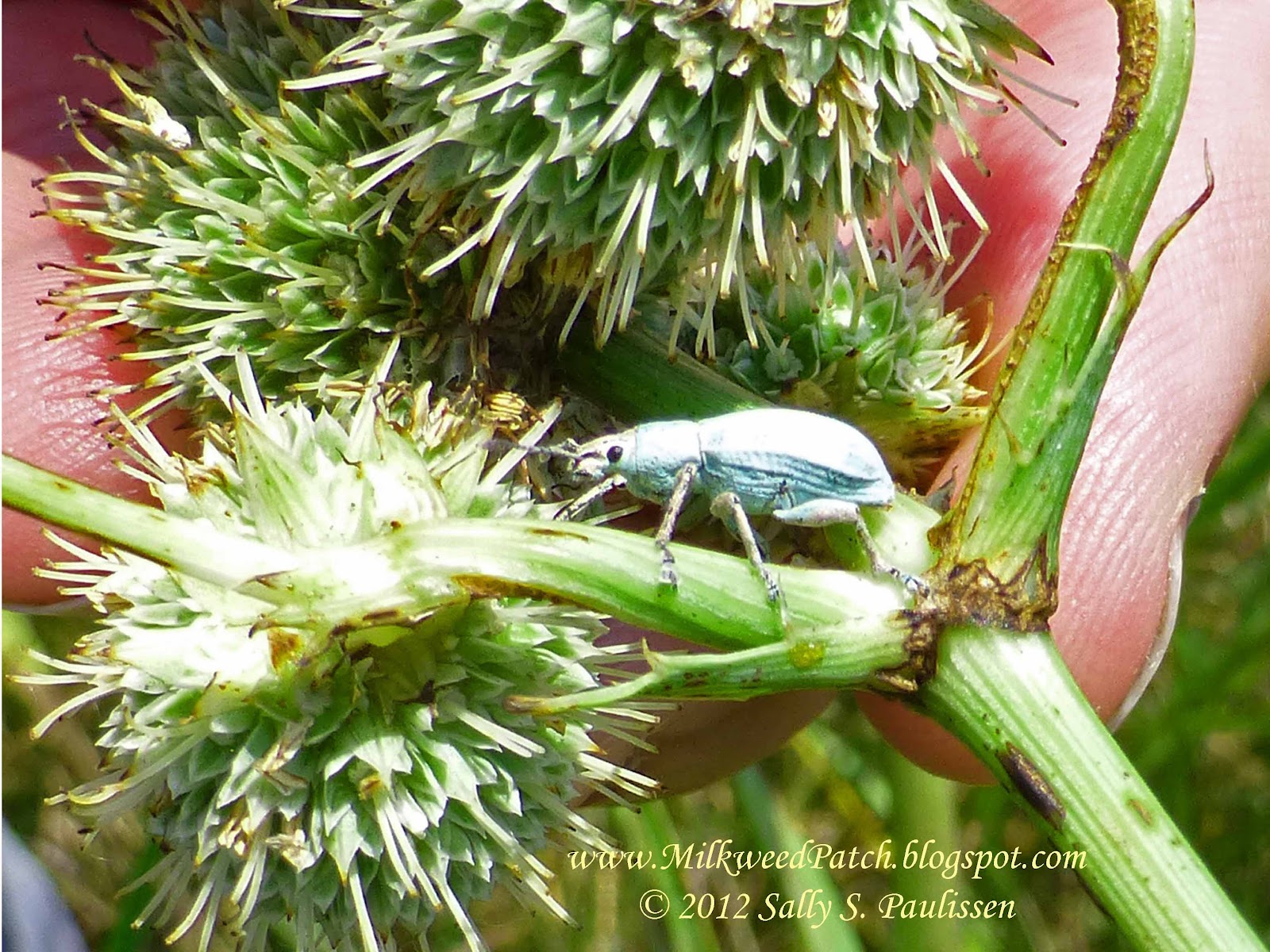
Gorgeous Golden-Headed Weevil, Compsus auricephalus, on Rattlesnake Master
Pretty Pink Inchworm on Rattlesnake Master

Nash Prairie, blooming Rattlesnake Master and Liatris, June 2012


Sunday, May 6, 2012

Plains Coreopsis

 Plains Coreopsis, Coreopsis tinctoria, in my garden.  Prairie Parsley is blooming pale yellow in the background.
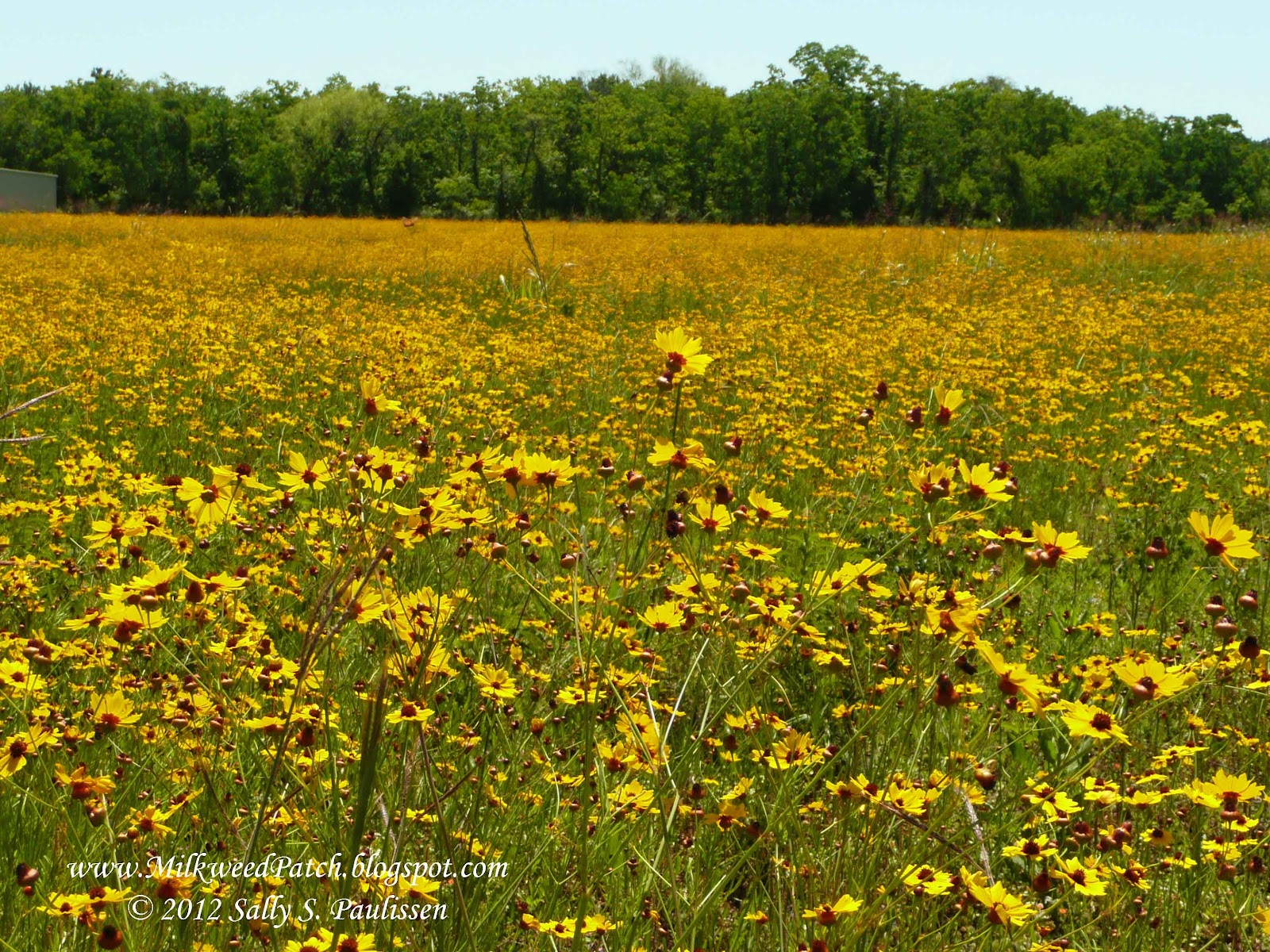
Ugh!  Traffic was at a standstill due to construction on Highway 96.   But happy distraction! I spied this field awash with gold. Plains Coreopsis, Coreopsis tinctoria, is one of our gorgeous natives.  Another common name, “Golden Wave”, aptly describes the dramatic, wind-blown mass of bright yellow blooms. The species name, tinctoria, comes from a Latin word referring to staining or dying.  That explains another common name, Dyer's Coreopsis. Weavers and spinners who dye their own wool can use Plains Coreopsis blossoms to produce lovely natural dyes in shades of yellow, orange or brown.

Brilliant field full of Coreopsis tinctoria, Plains Coreopsis


I enjoyed it so much, I took another picture:  Field full of Coreopsis tinctoria, Plains Coreopsis. A lot of wool could be dyed from this!

Once you add Plains Coreopsis to your garden, it will re-seed and give you beautiful flowers again the following year.  Your butterflies and bees will love it!

A spot in my garden with Plains Coreopsis and various salvias.


Monday, March 12, 2012

Monarch Butterfly Emerges - With Video!

Sometimes you’re in the right place at the right time.  Earlier this month, I was bending over a pot full of milkweed, A. curassavica, where Monarch caterpillars had been feasting.  It was at that sad stage when there were a too few leaves and too many caterpillars.   I was affecting the outcome by moving the largest and healthiest caterpillar on to those remaining leaves.  There was also a chrysalis hanging on a Milkweed stem.   As I  hunched over, waiting for the disturbed caterpillar to relax, uncurl and grab a leaf,  I heard a soft sound near my face.  I turned my head and was looking directly at a Monarch about to emerge from his chrysalis. 

 I have been growing milkweed and observing Monarchs for about three years.  Often I find a recently emerged Monarch, wings like damp tissue paper, clinging to an empty chrysalis.  This was the first time I have actually observed one while it eclosed!  

 It happened fast.   I knew there was no point in running for my camera – the event would be over by the time I got back.  Plus, I still had on my finger a caterpillar which was slowly making its way on to a leaf.  So I relaxed,  widened my eyes, and prepared to absorb the rare experience.

You can Imagine my delight a when,  just a week later,  I spotted another chrysalis opening.   On this lucky morning,  I had my camera in hand!   I squatted, leaning against flower pot and started clicking pictures as fast as auto-focus would let me (which turned out to be about once every five seconds).  I was so tickled with the series of pictures, that I put them together in a Powerpoint presentation and saved it as a Windows Video.  The result is almost but not entirely unlike a video, but still gives you a good look at how a Monarch Butterfly escapes the chrysalis.  As you watch, remember that a few days ago, that elegant, winged animal was a caterpillar.  This is amazing and magical.

Click here (or copy and paste) to watch my YouTube video, "Monarch Butterfly Emerging"
 http://youtu.be/ZaObyFKI8oIh    


Friday, March 2, 2012

Diamondback Water Snake

Juvenile Diamondback Water Snake
I dragged a plastic bag full of old grass clippings and leaves to our new tumbling composter.  This bag was shredded from too many weeks in the sun.  When I peeked into the bag to remind myself of what was inside,   I was surprised to see some round, dark eyes peering back at me.   A young snake, only a few inches long,  flicked a tiny tongue in my direction.  What was my first response?  Right!  “Run to find the camera!”   Obviously the little guy stayed long enough for me to snap his portrait.  But by the time I put down the camera and returned to release him (or her), he was gone.

My copy of  A Field Guide to Texas Snakes by Alan Tennant says that this little fellow was  Nerodia rhombifer rhombifer , a Diamondback Water Snake.  These are non-venomous and are dangerous only to amphibians and small fish.   If molested, they will bite, just as any of us would.   I did not expect to see a Water Snake in my subdivision backward, but we have had lots of welcomed rain recently.