Showing posts with label Monarch Butterfly. Show all posts

Friday, September 16, 2011

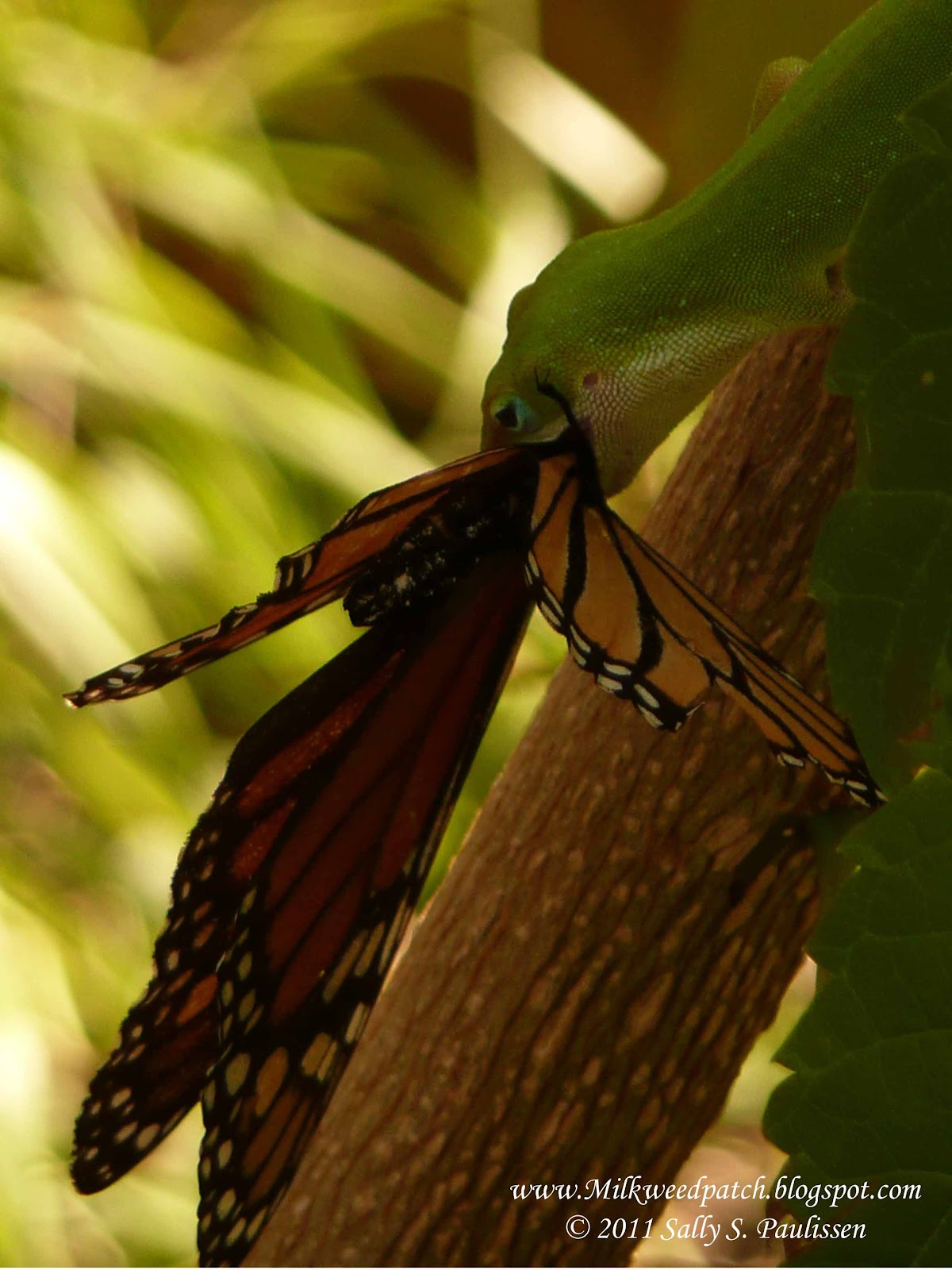
Green Anole eating Monarch Butterfly

So sorry for the lapse in posts;  I was without a computer for a while.  

Yesterday, I spotted my first female Monarch Butterfly of the fall.  She was busily laying eggs on the leaves of each milkweed, A. curassavica, in my garden.   After about 5 minutes of egg laying, she rested on a milkweed flower.   For another first, I reported my sighting to Journey North:    
http://www.learner.org/jnorth/monarch/   

About an hour later, I was back in the garden with the dogs and was dismayed to see a female monarch becoming a meal for one of our green anoles, Anolis carolinensis.  Monarchs contain toxic cardiac glycosides so many creatures avoid eating them.  Unfortunately, with our drought, there are not many insects at all.  Anoles must eat what they can find.  I am glad the Monarch was able to deposit her eggs. 
This Texas drought has made food scarce for insectivores.
See the anole's ribs? He must have been hungry.
The Monarch is still fighting.  She stuck her foot in the lizard's ear.

The next day:  Lizard resting with a fat tummy.  Does he feel ill?

Sunday, December 5, 2010

Preying Praying Mantis

Big compound eyes and sharp spines on forelegs
Basking in the morning sun; legs outstretched to snatch prey
Praying Mantis Looking like a cosmos leaf and watching the camera

Monarch for breakfast

European Praying Mantis consuming Monarch Butterfly

Where is it?  Some days I spot the European Praying Mantis in the garden and other days I don’t.  Its camouflage is so excellent that I may look directly at the mantid,  glance away at a butterfly, look back - and it has vanished!  Of course, it’s still hanging in the same spot, looking like a leaf and a flower stem.  The Praying Mantis needs this disguise to hide from birds such as Blue Jays and Mockingbirds.  But this insect, Mantis religiosa,  is a large and voracious predator.  Consider this: during a Hummingbird Festival, several of my Master Naturalist acquaintances reported hearing a hummingbird squeaking in distress.  When they investigated the source of the fuss, they discovered a Ruby-throated Hummingbird in the clutches of a Praying Mantis.  They confessed that they did intervene, using a pencil to carefully pry the tiny bird from the mantis’s  grip.   Another Master Naturalist friend recounted that as a child she and her sister would feed raw hamburger to mantids on her front screen door.  Interestingly, the next season, Praying Mantises returned to her screen!  In my garden, I have seen the Praying Mantis devour Green Anoles, bugs, moths, and to my great dismay, a Monarch Butterfly.   After that episode, I was emotionally and foolishly considering a “Praying Mantis Relocation Program”.  I wanted to move it away from the Milkweed Patch to a different part of the yard, but first, I would have to find it.  After two days and no sign of the mantid, I had calmed down.  The Praying Mantis is hunting, hidden in the garden.