Showing posts with label native plant. Show all posts

Sunday, May 1, 2011

Monarchs in the Milkweed Patch!

Early instar of Monarch Caterpillar on Asclepias curassavica
Monarch Caterpillars on A. curassavica.  How many do you see?
Four Monarchs munching - they are running out of leaves.
When the leaves are gone, but you're still hungry, gnaw on the stem. Monarch Caterpillar on A. curassavica.
Ultimate Instar of Monarch Caterpillar, Ventral View
Finished Monarch Chrysalis &  another caterpillar in J-Stage, preparing to shed skin and form chrysalis.
Newly eclosed Monarch
     Yay!  Monarchs! They are the reason we plant milkweed (Asclepias spp.) They are having such difficulties that I am thrilled when they can rest, refuel and reproduce in my garden & my Milkweed Patch.  I am a registered Monarch Waystation; perhaps they see the sign?
          A nice brood developed in mid-December. It was probably too early for butterflies to be migrating north from Mexico, so I believe it was a year-round resident female monarch who visited.   Alas, the day several adults eclosed (hatched), we had unusual, record-breaking, freezing weather that lasted for days.
     By the end of March, another female monarch found my milkweed.  How do they find it, I wonder?  A nice bunch of caterpillars grew fat munching on the fresh milkweed. We counted eight jade-green chrysalides suspended from the soffits;  there were surely more in the shrubbery or on the flowers that we did not see.
     Safe journey north, little guys.

Monday, January 24, 2011

Red Admiral

Red Admiral basking on Oak Tree

Red Admiral, Vanessa atalanta,  nectaring at Salvia, Indigo Spires
The Red Admiral's bold markings are distinctive, even at a distance.

The water in the birdbaths had frozen solid overnight and was slowly melting in the late morning sun.   This had been a cold January by Galveston County standards, so I was surprised to see a butterfly nectaring at the blossoms of the indigo spires salvia.  Of course I had to go see who it was, but the critter startled easily and flew away fast.  I dismayed of ever getting a photo.  Fortunately, it settled comfortably on the sunny side of our Nutall Oak Tree.  Spreading its wings wide, with its head toward the ground,  it basked in the winter sunlight and soaked up some rays.  This battered butterfly needed a sip of nectar and a solar recharge.  After a while, the Red Admiral was flying again.   

For that’s what is was - a Red Admiral, Vanessa atalanta,  quite easy to identify once it sat still.  Red Admirals are among the family Nymphalidae, the Brush-Footed Butterflies.   Brush-footed butterflies have tiny, vestigial forelegs.  This is not visible in my Red Admiral photos, but if you look back to my “Fritillary Euthanasia” entry, you may see the reduced front legs.  Another characteristic which you can see are the prominent knobs on the antennae. This species has a huge range - nearly all of North America and parts of Central America. Masses of Red Admirals have been known to migrate south, but adult Red Admirals can hibernate during the winter, as can the pupae.  I am sure in our southern county the temperatures are confusing. Their larval host plants include nettles, Urticaceae,  and other plants in that family.  

Several of my books mention that if you have a Red Admiral in your summer garden, it may regularly rest on your arm or shoulder.  Is this territorial butterfly trying to scare you away from its food source?  Are you a convenient basking spot or it is sipping salt and minerals from your skin?   Either way, how delightful to have a butterfly rest upon you!

Friday, December 31, 2010

Little Hive on the Prairie

Wild Honey Bees, Apis mellifera

Honey Bees Clustering on Hive
Honey bee hive hanging from abandoned oil field equipment.

The dark ball hanging under the center of the broken ramp is the bee colony.

     The Master Naturalists finished sprigging a mess of Eastern Gamagrass and bumping up Yellow Indiangrass seedlings.  We had extra time on this last workday before Christmas, so the Nature Conservancy Technician, Tim O'Connell, treated us to a ride out on the Prairie.  He promised to show us something special.  From the pick-up truck, we saw hawks, sparrows, killdeer, geese, caracaras, and an osprey, but the surprise was a hive of wild honey bees!
     We were in a remote part of the prairie preserve.  Tim pointed out a dark mass hanging beneath a piece of abandoned oil field metalwork.  As we approached, we could see the honey bees clinging to curtains of wax comb.  We moved slowly and kept our distance.  Although it was wintertime, astronomically speaking, the air temperature was in the 70s F,  plenty warm enough for bees to fly in defense of the hive if they perceived us as a threat.
     The Honey Bee, Apis mellifera, is revered on this planet for unsurpassed pollinating skills, as well as honey and wax production.   The subspecies, A.m ligustica, is the most common western honey bee in Texas.  Africanized Honey Bees, which also live in Texas, encompass different subspecies, such as A.m. intermissa.  You cannot distinguish one type of honey bee from another other just by looking at them.     However, the Africanized Honey Bees are much more aggressive in defending their hive than are the western honey bees.
    Wild bees often make their nests in the hollow of a tree;  Live Oaks, which keep their leaf canopy year 'round, are popular.  The bees look for a spot that will be within easy flying distance of water, pollen and nectar.  They also favor a location that offers some protection from the weather.   Because there are not many trees on the Texas City Prairie Preserve, these  insects had to be resourceful.  The colony will live through the winter, surviving the cold days by clustering together.  We were delighted to see this healthy hive of pollinators on the prairie.

This is a brand new subject for me.  If you like, you can read more about bees here:

Sunday, September 26, 2010

Funereal Duskywing

This butterfly, nectaring from cosmos in my August garden, could be in formal attire or dressed in mourning colors with a white petticoat showing under the black dress.  It's the descriptively named  Funereal Duskywing with sooty wings and white fringe along the edges of the hindwing.  This lovely Funereal Duskywing , Erynnis funeralis is just one example of the skipper butterflies.  Taxonomists do not consider skippers to be “true” butterflies because they differ in so many ways.  For example, skippers look a little like moths with their stocky, feathery bodies and big, cute eyes.   The tip of a skipper’s  antennae has a curved, pointy club. To me it looks like a sickle or a pointed hockey stick.  True butterflies’ antennae do not curve back.   As this Duskywing demonstrates, skippers are usually cloaked in subdued shades of charcoal, chocolate, amber, copper, or bronze.   Larval host plants for the Funereal Duskywing include alfalfa,  indigo, vetch, and rattlebush.  Remember, if you want butterflies, you have to provide food for the babies and nectar for the adults.

Tuesday, June 29, 2010

Monarchs have Arrived - Finally!

Monarch Butterflies are visiting my garden this week.  I was so happy to see the tell-tale holes eaten through the leaves.  Then I spotted this little stripey fellow sunning on his leaf. Usually the babies hide safely beneath the leaves.  An adult monarch stopped buy to sip nectar from my American Basketflower.  One plump caterpillar was crawling up the warm brick wall heading toward the eves, preparing to make a chrysalis.  I hope he fastens on tightly because Hurricane Alex is expected to give us a lot of wind and rain. 

Friday, April 9, 2010

Little Yellow Frogs


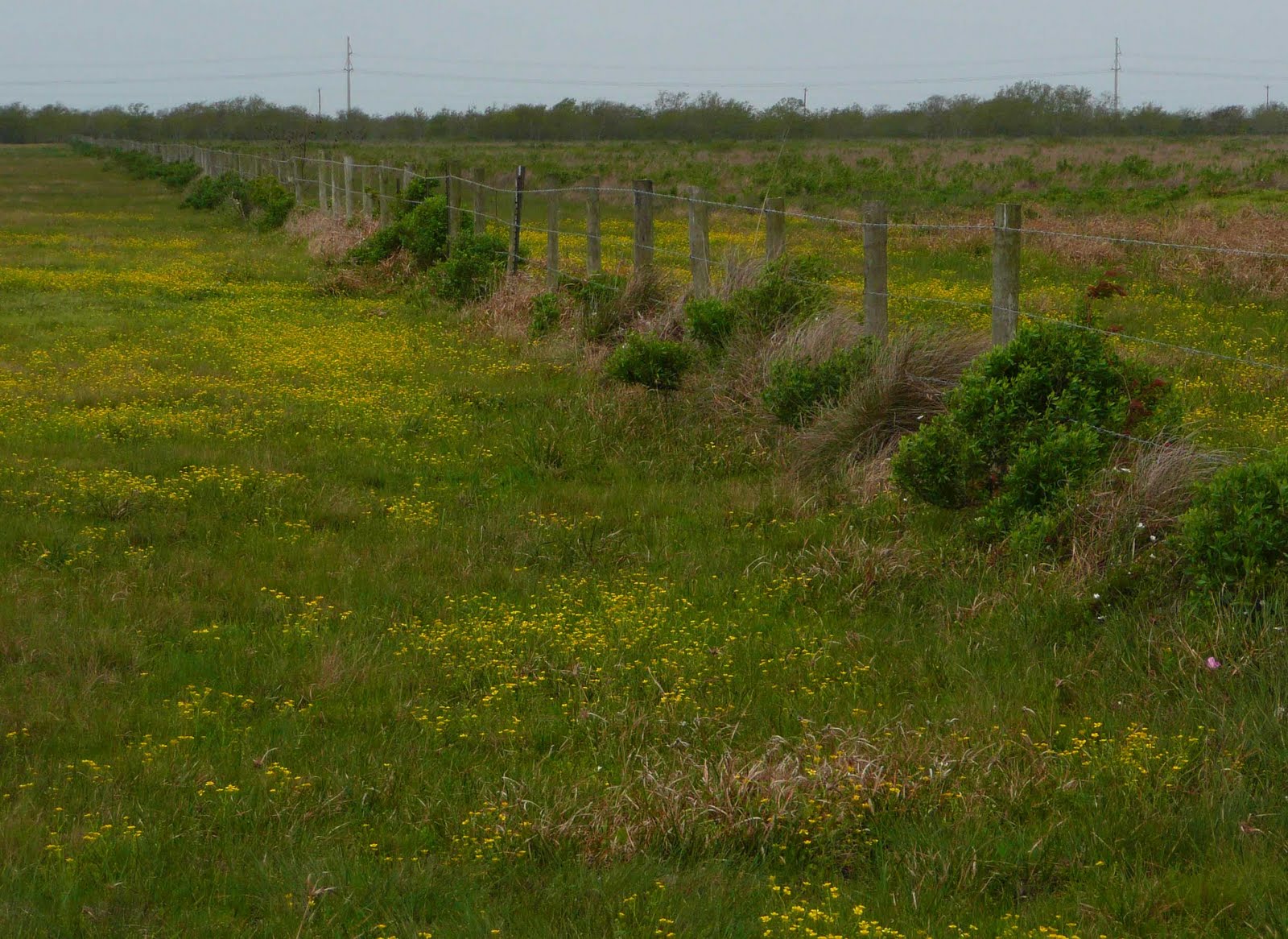
Butter-yellow flowers are blooming in my backyard, sprinkled through the grass. The variety appearing in the subdivision is so short that it escapes the blades of the lawn mower. A friend denounced the sunny blooms as “broad-leafed weeds”.  I pointed out that they are native wildflowers called Buttercups or Ranunculus spp.. Their name is Latin for “little frog”. Perhaps they were dubbed Ranunculus because they tend to grow in wet areas and in ditches.     The Buttercups I see on the prairie are much taller, up two feet. My wildflower book says there are about five species of Ranunculus . They are especially beautiful because in the sun, the yellow petals shine like glazed porcelain. Some people think they look wet. Touch one gently; you will find it smooth and dry.