Showing posts with label habitat. Show all posts

Friday, July 15, 2011

Frogs in the Kitchen - and Other Thirsty Critters


Rio Grande Chirping Frog

This is the worst drought in Texas’s weather history.  Along with the drought comes record breaking heat.   During last week’s prairie restoration workday, the Master Naturalists encountered lots of thirsty critters.  Animals that were naturally shy, reclusive, or nocturnal exposed themselves for a chance to reach water. 

Because of the drought, our usual prairie planting activities have halted.  Instead, we water.   John S., Tom B. and I drove into Attwater’s Prairie Chicken territory with a 275 gallon water tank and a bunch of buckets to care for our spring transplants.   Tom B., with his raptor-like vision, noticed that when he poured a gallon of water on a Yellow Indian Grass, little cotton rats would scurry out from deep cracks in the clay.  The usually timid rats would try desperately to lap the water before it vanished into the parched ground. As we filled containers, water sloshed forming a small muddy spot.  Two little sulfur butterflies soon settled on the puddle to sip.  Back at the tractor barn, we saw Texas City Prairie Preserve’s resident family of Crested Caracaras  swooping in to dip their beaks in a cow’s water trough.   Tom observed a swarm of honey bees that clustered briefly on a dripping water tank so the colony could drink. 

In my home, twice this week, I have found frogs in the kitchen.  The tiny Rio Grande Chirping Frogs, Eleutherodactylus (Syrrhophus) cystignathoides,  have come inside searching for water.  This desperate survival measure must be something other local frogs are trying:  Tom B. said he also found a frog in his kitchen this week.  He discovered a Green Treefrog, Hyla cinerea, soaking in the dog’s water bowl. 
Like other folks, I try to help:  I keep four birdbaths filled.  One of those is a dish hanging against the trunk of a shrubby tree.  Hopping from a nearby fence line, the squirrels can reach this sheltered water source without ever touching the ground.   Green anoles climb to sip in the shade.    For frogs, toads and geckos, I put a pan on the ground, near a popular amphibian hang-out.  I placed smooth stones around and inside the pan, so little critters could get in and out easily.      
Using  a critter catcher, a Schwegler Naturschutz, I scooped him up and took him outside. Can you see him? (Rio Grande Chirping Frog.) 

Rio Grande Chirping Frog:  Notice the pointed nose and dark spots,

as well as the dark stripe from eye to nose - all identifying features.

The tangle of dog fuzz from my kitchen floor was quite a handicap.  This frog was tired and easy to rescue.

Eleutherodactylus (Syrrhophus) cystignathoides are tiny, fast and secretive.  They are hard for me to photograph.  Thus I had to get lots of pictures of this one.

Rio Grande Chirping Frog making his exit from the critter catcher

An early-rising anole darted after him here, so I intervened and scooped him up again. (Rio Grande Chirping Frog)

 I put him down near my amphibian watering bowl. (Rio Grande Chirping Frog)

Sunday, May 1, 2011

Monarchs in the Milkweed Patch!

Early instar of Monarch Caterpillar on Asclepias curassavica
Monarch Caterpillars on A. curassavica.  How many do you see?
Four Monarchs munching - they are running out of leaves.
When the leaves are gone, but you're still hungry, gnaw on the stem. Monarch Caterpillar on A. curassavica.
Ultimate Instar of Monarch Caterpillar, Ventral View
Finished Monarch Chrysalis &  another caterpillar in J-Stage, preparing to shed skin and form chrysalis.
Newly eclosed Monarch
     Yay!  Monarchs! They are the reason we plant milkweed (Asclepias spp.) They are having such difficulties that I am thrilled when they can rest, refuel and reproduce in my garden & my Milkweed Patch.  I am a registered Monarch Waystation; perhaps they see the sign?
          A nice brood developed in mid-December. It was probably too early for butterflies to be migrating north from Mexico, so I believe it was a year-round resident female monarch who visited.   Alas, the day several adults eclosed (hatched), we had unusual, record-breaking, freezing weather that lasted for days.
     By the end of March, another female monarch found my milkweed.  How do they find it, I wonder?  A nice bunch of caterpillars grew fat munching on the fresh milkweed. We counted eight jade-green chrysalides suspended from the soffits;  there were surely more in the shrubbery or on the flowers that we did not see.
     Safe journey north, little guys.

Saturday, July 31, 2010

Green Lynx Spider

Peucetia viridians, Green Lynx Spider
Green Lynx Spider Resting on Cosmos
Young Green Lynx on Fennel Blossoms
I have been watching this lovely spider.  He had claimed one particular cosmos blossom and could be found there daily.  When the bloom began to drop petals, he still was loyal.  When the flower switched from nectar-producing to seed-producing, the spider moved to a neighboring, fresh cosmos.  His position must have nectar to lure prey, after all.  During the day, his colors help hide him from birds.  At night, the Green Lynx  assumes a more expectant posture:  I see the Lynx hang forward off the edge of the petals, his front two legs raised and extended, ready to pounce and seize.  One bit of silk might be secured as a drag line.  There is no web. The Green Lynx is a hunter.

Thursday, July 8, 2010

Clapper Rail

When I stopped on the prairie to photograph sulphur butterflies puddling on a cow patty, somebody else caught my eye.  At first I thought it was one of our juvenile Attwater's Prairie Chickens!  But one glance at the long beak corrected that idea.  It was a large brown bird slowly stalking through the grass near a culvert and drainage ditch.  This was a spot where there was usually standing water, but now the ground was hard, dry and cracked because of our scorching, dry weather.  He took cover in a thicket of short Rattlebox trees to preen briefly, then strutted back into the culvert beneath the gravel road.  The Preserve Manager identified him for me - a Clapper Rail.

Little Sulphurs

There have been clouds of these small, flitty sulphur butterflies on the prairie.  During our dry spell, the dainty insects gathered to sip moisture in the only place it could be found - in fresh cow manure.

Thursday, July 1, 2010

Green Anole

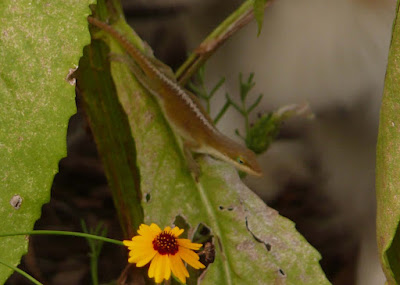
This green anole, (Anolis carolinensis) does not look green at all as he - or she- relaxes on a basketflower leaf.  Even watching me, he is unconcerned, legs outstretched, all comfy.  He knows I don't eat the lizards in my yard, I suppose.  But suddenly my dog passes under his leaf.  Presto! Change-o!  The anole switches his color from brown to green, to hide from the canine predator.


Tuesday, June 29, 2010

Monarchs have Arrived - Finally!

Monarch Butterflies are visiting my garden this week.  I was so happy to see the tell-tale holes eaten through the leaves.  Then I spotted this little stripey fellow sunning on his leaf. Usually the babies hide safely beneath the leaves.  An adult monarch stopped buy to sip nectar from my American Basketflower.  One plump caterpillar was crawling up the warm brick wall heading toward the eves, preparing to make a chrysalis.  I hope he fastens on tightly because Hurricane Alex is expected to give us a lot of wind and rain. 

Sunday, April 4, 2010

Cedar Waxwings

Flocks of these beautiful birds migrate through our county in the winter.  They like to eat berries and insects.  My photos don't show the eponymous bright red feathers on their wings - like drops of sealing wax.
Two years ago, I drove past a new industrial park.  It was a damp morning, cold by south Texas standards.  In one of the short, bare-limbed landscaping trees there huddled about eighty cedar waxwings.  They were puffed, with their beaks to the wind, clustered only a few feet about the ground in that small tree.  I am sure they were confused because when they visited this same location the previous year, there existed a nice patch of prairie and a scattering of mature trees.  Maybe there had been a mulberry tree or native holly.  Migrating birds have incredible site loyalty.  They will return to the exact location year after year to hunt, feed or nest.  It can be disastrous for them to return to find no habitat and non-native plants. 

This week, I went to a shopping center and parked next to a holly tree covered with red berries.  Nice.  As I got out of the car I heard the impossibly high-pitched, yet very soft "tsee-tsee-tsee" of the cedar waxwings.  Luckily, my little camera was with me.  The birds would not let me get very close before they flew to another tree.  I know the other shoppers wondered what the heck I was doing - walking slowly, slowly snapping pictures while I crossed the parking lot.  Credits to the planners of this center that they DID plant vegetation that was useful to the wildlife.

Wednesday, March 31, 2010

Spider Lily


The highway runs through a patch of wetlands. The spider lilies, Hymenocallis liriosme, are exploding there now. Yesterday the Master Naturalists transplanted scores of greenhouse-raised spider lilies into the Nature Conservancy Wetlands. The plants which we released back into the wild had been grown from seeds of these native lilies along the roadside. Soon we will have to gather more seeds for next year.

April 23, 2011  I added the photo taken with my mobile phone which shows the seeds of this native lily.  Growing lily plants from the seeds will take more than a year of care.  Next year, after a the plant has developed a bulb, it can be transplanted.  The seeds look just like green eggs and as we were collecting them prior to Easter, we Master Naturalists surely felt that we were on an Easter Egg Hunt.
These look like green bird eggs, but these are the Spider Lily Seeds.