Saturday, July 31, 2010

Green Lynx Spider

Peucetia viridians, Green Lynx Spider
Green Lynx Spider Resting on Cosmos
Young Green Lynx on Fennel Blossoms
I have been watching this lovely spider.  He had claimed one particular cosmos blossom and could be found there daily.  When the bloom began to drop petals, he still was loyal.  When the flower switched from nectar-producing to seed-producing, the spider moved to a neighboring, fresh cosmos.  His position must have nectar to lure prey, after all.  During the day, his colors help hide him from birds.  At night, the Green Lynx  assumes a more expectant posture:  I see the Lynx hang forward off the edge of the petals, his front two legs raised and extended, ready to pounce and seize.  One bit of silk might be secured as a drag line.  There is no web. The Green Lynx is a hunter.

Thursday, July 29, 2010

Hooker's Eryngo

A starry ground:  Hooker's Eryngo, Eryngium hookeri
Bumble Bee gathering nectar
Honey Bee sipping nectar
Have you ever seen something for the first time and found it so beautiful or unusual that you felt dazzled?  That was my experience with this stunning native flower.   Its color ranges from green to shades of purple and silver.  As you can see, it is a wonderful nectar source for the pollinators.  It looks sharp and prickily  and it is!  Those points will go right though blue jeans.  I imagine that is how the Eryngo protects itself from being chomped by grazing animals.  We can grow this summer annual from seeds in our Texas gardens.

Thursday, July 8, 2010

Clapper Rail

When I stopped on the prairie to photograph sulphur butterflies puddling on a cow patty, somebody else caught my eye.  At first I thought it was one of our juvenile Attwater's Prairie Chickens!  But one glance at the long beak corrected that idea.  It was a large brown bird slowly stalking through the grass near a culvert and drainage ditch.  This was a spot where there was usually standing water, but now the ground was hard, dry and cracked because of our scorching, dry weather.  He took cover in a thicket of short Rattlebox trees to preen briefly, then strutted back into the culvert beneath the gravel road.  The Preserve Manager identified him for me - a Clapper Rail.

Little Sulphurs

There have been clouds of these small, flitty sulphur butterflies on the prairie.  During our dry spell, the dainty insects gathered to sip moisture in the only place it could be found - in fresh cow manure.

Thursday, July 1, 2010

Green Anole

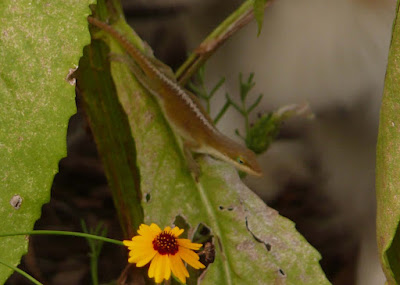
This green anole, (Anolis carolinensis) does not look green at all as he - or she- relaxes on a basketflower leaf.  Even watching me, he is unconcerned, legs outstretched, all comfy.  He knows I don't eat the lizards in my yard, I suppose.  But suddenly my dog passes under his leaf.  Presto! Change-o!  The anole switches his color from brown to green, to hide from the canine predator.


Tuesday, June 29, 2010

Monarchs have Arrived - Finally!

Monarch Butterflies are visiting my garden this week.  I was so happy to see the tell-tale holes eaten through the leaves.  Then I spotted this little stripey fellow sunning on his leaf. Usually the babies hide safely beneath the leaves.  An adult monarch stopped buy to sip nectar from my American Basketflower.  One plump caterpillar was crawling up the warm brick wall heading toward the eves, preparing to make a chrysalis.  I hope he fastens on tightly because Hurricane Alex is expected to give us a lot of wind and rain. 

Tuesday, June 8, 2010

Bodacious Jumping Spider

A white smiling face on velvety black is what I spotted. Then I was stunned by flashes of green from the spider's real face.  Those were not his eight, laser-sharp eyes glinting at me, but his shiny, emerald chelicerae - his jaws!  The metallic-green chelicerae are his weapons. The jaws are tipped with sharp fangs and poison ducts which he uses to immobilize his prey.  Jumping spiders are not dangerous to people, but like anyone, they may bite if handled.  Jumping spiders, (family Salticidae, from Latin, saltus = to jump), do not rest on webs waiting for food to be delivered.  They hunt.  They have amazing, binocular vision - the best eyesight of all spiders - and formidable agility.  For a jumping spider, a web is essential safety equipment.  Before making a dramatic pounce on his prey, he would secure a web line so that he could climb back.  This striking fellow, who was stalking amidst my salvias, is Phidipus audax.  He would court a female by waving his atractive front legs at her and wiggling his abdomen.  Audax is a Latin word meaning bold or audacious.  One of my arachnid books labels him the "Daring Jumping Spider," another dubs him the "Bold Jumping Spider."  I may call him the "Bodacious Jumping Spider."

Sunday, June 6, 2010

Green Treefrog

Look at the charming face on this handsome green treefrog, Hyla cinerea.  Wouldn't you love to have golden eyes?  This dapper fellow was resting inside my hose reel box. I had to wait for him to move off of the hose and get settled in another corner before I could water the thirsty plants.


Loggerhead Shrike

I look so cute and fluffy, yes?  But don't be fooled.  I'm the Loggerhead Shrike, Lanius ludovicianus.  See my sharp, hooked beak?  All the better for tearing and dismembering my prey.  I am tough like a little raptor!  Some folks call me the Butcher Bird just because I like to store my food on a thorn or barbed wire.  If you find an impaled grasshopper, lizard or mouse, leave it alone - you may be looking at my leftovers.

Wednesday, May 12, 2010

Io Moth Rescue


My little mixed-breed dog was pretending to be a terrier.  He plowed through the Cosmos and Coreopsis looking for a rat. Alas, in the process, he trampled a beautiful Io Moth.  The moth tried to scare away my dog by displaying his eyespots - his only defense.  The behavior was actually helpful because the display allowed me to spot the moth and remove him from danger!   Automeris io is in the family of Giant Silk Moths, Saturniidae.  They make silk cocoons in the leaf litter, so this unfortunate male (males are yellow, females are ruddier) may have recently emerged.  The caterpillars use many kinds of trees for food - probably oak in my yard.  The adults exist only to reproduce and do not eat.  This fellow did have some wing damage, but he was able to fly from my hand and take cover in a shrub.  With his wings folded, he looked like a yellowed leaf and was well-hidden.  I love moths.